
Tennessee's Open Container Law Is Different for Drivers and Passengers
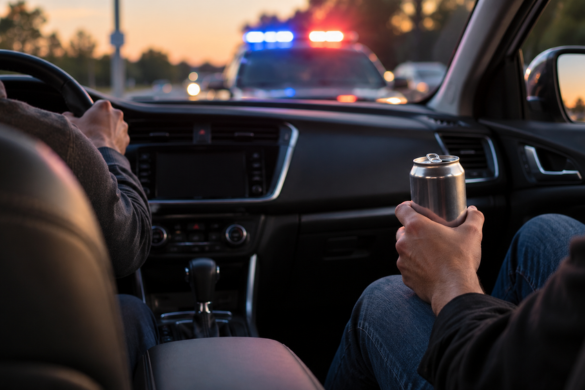
A passenger opens a beer while a friend drives home from a concert. The driver hasn't been drinking, but if police pull the vehicle over, can anyone get a ticket?
In Tennessee, the answer depends on who has the alcohol and where the vehicle is traveling. State law prohibits drivers from drinking alcohol or possessing an open container while operating a vehicle. It does not impose that same statewide prohibition on passengers, although cities and counties have authority to adopt stricter local rules.
For drivers, the distinction is especially important. An open container found during a traffic stop can lead to questions about alcohol consumption and, in some cases, a DUI investigation. Herbert & Lux represents drivers and passengers facing criminal charges arising from traffic stops in Nashville and throughout Middle Tennessee.
Is It Legal for a Passenger to Drink Alcohol While Someone Else Drives?
Under Tennessee Code § 55-10-416, the statewide open container restriction is directed at the driver. This means a passenger's possession or consumption of alcohol is not automatically a violation of that particular state law.
Local rules can change the answer. Tennessee expressly allows municipalities and counties to prohibit passengers from drinking or possessing open containers while a vehicle is being operated. Before assuming passenger drinking is permitted, it is important to consider the rules that apply in the location where the stop occurred.
The law also distinguishes between alcohol held by a passenger and alcohol that may be attributed to the driver. A passenger holding an open beer is a different situation from an open bottle left in the center console where nobody claims possession.
Can the Driver Get a Ticket for a Passenger's Open Container?
Yes, depending on the circumstances. Tennessee law treats an open container as being in the driver's possession when it is not possessed by a passenger and is not stored in a closed glove compartment, trunk, or another nonpassenger area of the vehicle.
Consider a driver who has not consumed alcohol but has an open can sitting in a cupholder. Even if a passenger brought the drink into the vehicle, its location and who possessed it may become central questions if the driver receives an open container citation.
A violation of Tennessee's statewide open container law is a Class C misdemeanor punishable by a fine only. The statute generally calls for a citation rather than continued custody, subject to its specified exception.
Can an Open Container Lead to a DUI Arrest?
An open container does not prove that the driver was impaired. Police may still investigate whether the driver has been drinking, particularly if they report observing signs of impairment or have other evidence suggesting a DUI offense.
That investigation can involve questions about recent alcohol consumption, roadside sobriety exercises, and requests for chemical testing. The fact that a passenger was drinking does not establish that the driver consumed alcohol, and a DUI charge requires proof of its own legal elements.
This is where the details of a traffic stop matter. Herbert & Lux examines the officer's stated reason for stopping the vehicle, what was observed before the DUI investigation began, and whether the evidence supports the charge. Police recordings and test results may be important when the officer's account is disputed.
What if You Were Cited or Arrested After Police Found Alcohol in the Car?
The right defense depends on the charge. For an open container citation, questions may include where the alcohol was found, whether it was open, who possessed it, and whether the vehicle was in operation. Tennessee defines a vehicle as being in operation when its engine is running, even if the vehicle is not moving.
If the stop resulted in a DUI arrest, the inquiry is broader. Herbert & Lux reviews the evidence of impairment, the circumstances of any search, and the procedures police followed. An open container and a DUI are not interchangeable offenses, and the evidence must be evaluated against the requirements of each charge.
Eddie Herbert previously represented clients in Davidson County General Sessions and Criminal Court through the Public Defender's Office. Ron Lux brings a law enforcement background to the firm's review of police investigations. Together, their experience helps Herbert & Lux assess what happened during a stop and identify issues that may affect a client's defense.
Charged After a Traffic Stop? Contact Herbert & Lux.
A traffic stop involving alcohol can result in more than a simple citation, particularly when police also suspect impaired driving. Herbert & Lux defends DUI and criminal charges in Nashville and throughout Middle Tennessee, with clients working directly with the firm's attorneys.
If you received an open container citation or were arrested for DUI after police found alcohol in your vehicle, contact Herbert & Lux to discuss the circumstances. You can also learn more about our Nashville DUI defense practice.